Business Ideas in Textile Industry: 15 Profitable Opportunities to Explore

Summary
The textile industry is one of the oldest and most resilient sectors in global manufacturing. It spans everything from spinning raw fibers into yarn and weaving woven fabric to producing finished garments, home furnishings, and high-performance technical textiles used in healthcare, agriculture, and construction. For entrepreneurs looking for a proven yet evolving space, exploring business ideas in the textile industry remains one of the smartest moves in 2024–2026.
Table of Content
- Introduction to Textile Business Opportunities
- Why Start a Business in the Textile Industry?
- 15 Profitable Business Ideas in the Textile Industry 3.1 Garment Manufacturing Business 3.2 Textile Wholesale Business 3.3 Fabric Manufacturing 3.4 Textile Printing Business 3.5 Embroidery Business 3.6 Home Textile Business 3.7 Sustainable Textile Business 3.8 Textile Dyeing Business 3.9 Textile Finishing Business 3.10 Uniform Manufacturing Business 3.11 Custom T-Shirt Printing Business 3.12 Textile Accessories Business 3.13 Handloom and Artisan Textile Business 3.14 Textile Export Business 3.15 Textile Retail Business
- How to Choose the Right Textile Business Idea?
- What Do You Need to Start a Textile Business?
- Common Challenges in the Textile Industry
- How Textile Manufacturing Software Helps Manage Operations
- How Technology Can Support Textile Business Growth
- How LOGIC ERP Helps Textile and Garment Businesses
- Conclusion and Next Steps
- Frequently Asked Questions
Introduction to Textile Business Opportunities in 2024–2026
The global textile market was valued at approximately US $1,976.84 billion in 2024, and the Indian textile industry is a major contributor to that figure. India’s textile industry employs over 45 million people, making it the second-largest employer in the country after agriculture. In FY 2025-26, India’s textiles and apparel exports crossed ₹3,25,339 crore, growing at a CAGR of roughly 4.7% from FY 2023-24. Textiles and apparel have high demand in India and across export markets spanning the US, EU, Middle East, and Africa.
So why is 2024–2026 a particularly strong window? Several forces are converging: rising e-commerce adoption is creating new D2C channels, government export incentives and PLI schemes are reducing barriers, and global demand for sustainable textiles is opening premium niches. Garment manufacturing hubs like Tiruppur, Surat, and Ludhiana are scaling rapidly. India’s per-capita textile consumption sits at roughly 5 kg per year compared to the global average of 15 kg, which signals massive untapped domestic market potential.
This article presents 15 profitable textile business ideas, then goes deeper into how to choose, plan, and manage them. The ideas range from low-investment, home-based operations to full-scale textile manufacturing business setups. While the focus leans toward India, these opportunities are globally applicable.
Here is the quick snapshot before we dive in.
Quick Overview: 15 Best Textile Business Ideas
| # | Business Idea | Investment Level | Model | Typical Profit Margin |
|---|---|---|---|---|
| 1 | Garment manufacturing unit | Medium–High | B2B / B2C | 8–25% net |
| 2 | Textile wholesale business | Low–Medium | B2B | 15–25% |
| 3 | Fabric manufacturing | High | B2B | 10–18% |
| 4 | Textile printing business | Low–Medium | B2B / B2C | 20–35% |
| 5 | Embroidery services | Low–Medium | B2B / B2C | 25–40% |
| 6 | Home textile business | Medium | B2B / B2C | 15–30% |
| 7 | Sustainable textile brand | Medium | B2C / Export | 20–35% |
| 8 | Textile dyeing unit | Medium–High | B2B | 15–25% |
| 9 | Textile finishing & washing | Medium–High | B2B | 15–25% |
| 10 | Uniform manufacturing | Medium | B2B | 15–25% |
| 11 | Custom T-shirt printing | Low | B2C / B2B | 25–40% |
| 12 | Textile accessories business | Low | B2B | 15–25% |
| 13 | Handloom & artisan textiles | Low–Medium | B2C / Export | 25–45% |
| 14 | Textile export business | Medium–High | B2B | 20–35% |
| 15 | Textile retail store | Medium | B2C | 30–50% gross |
Small-scale textile businesses require investments of Rs. 5-10 lakhs for many of these ideas, while larger manufacturing setups may need ₹25 lakh to several crores depending on scale and automation.
Why Start a Business in the Textile Industry Now?
The textile sector contributes significantly to the Indian economy, accounting for roughly 2.3% of GDP, 7% of industrial output, and over 12% of export earnings. India’s technical textiles sector is projected to grow significantly by 2030, with exports already reaching US $2.6 billion in FY 2024 at a CAGR of 6–6.5%.
Here is what makes this a compelling business opportunity right now:
- Large and diverse customer base: Fashion, home décor, hospitality, healthcare, automotive, agriculture, and construction all consume textile products.
- Scope across B2B and B2C: From garment manufacturing for export houses to running your own textile business as a D2C clothing brand.
- Suitable for every scale: Small scale textile business ideas with low investment coexist alongside large integrated manufacturing business setups in the same ecosystem.
- Rising demand for sustainable products: Consumer preference for eco-friendly materials is on the rise. India’s sustainable fabrics market is projected to grow from US $42.6 billion in 2025 to US $71.9 billion by 2031.
- Multi-channel selling: Retail, wholesale, online D2C, marketplaces, and export business channels are all accessible.
The textile sector is shifting from conventional manufacturing to tech-driven segments, creating fresh openings for new businesses that combine domain knowledge with modern operational tools.
Garment Manufacturing Business: From Idea to Production Line
Garment manufacturing remains one of the most popular textile business ideas in India and globally. India’s RMG exports alone reached ₹1,39,350 crore in FY 2025-26. The garment industry serves domestic retail, e-commerce brands, and international buyers across multiple product categories.
Types of garments to specialize in:
- T-shirts, polo shirts, and activewear
- Denim jeans and casual wear
- Ethnic wear: sarees, kurtis, sherwanis
- Kids garments and school uniforms
- Leather garments and winter jackets
- The undergarment market is rapidly expanding across all income levels
The basic production process flows through: fabric sourcing → pattern making → marker making → spreading and cutting → stitching → finishing (pressing, washing, trims) → quality control → packing and dispatch.
For a small unit in India, you can start a textile business with 10–20 machines at an investment of roughly ₹10–25 lakh. According to IMARC Group, well-run garment manufacturing units in India achieve net profit margins of 8–15%, with IRR of 18–28% and payback periods of 3–5 years. Raw materials typically account for about 60% of cost, labour 15–25%, and the rest goes to overhead.
Production planning, line balancing, and garment production management software become essential the moment you scale beyond a handful of machines. Managing multiple sizes, colors, and styles manually leads to errors, delays, and margin erosion.
Textile Wholesale Business and Fabric Trading
A wholesale business involves buying fabric or garments in bulk from producers and selling to retailers, boutiques, garment manufacturers, and export houses. It is a high-volume, high-turnover model that can start with relatively low capital investment.
Types of wholesale models:
- Grey (greige) fabric trading
- Finished fabric distribution
- Ready-made garment wholesale
- Home textile wholesale
Key sourcing hubs in India:
- Surat: dress materials, sarees, synthetic fabrics
- Bhilwara: suiting and woven fabric
- Tiruppur: knitwear and hosiery
- Delhi and Mumbai: mixed stock and multi-category trading
- Panipat: home textile weaving
A textile wholesale business can start from ₹3–5 lakh if focused on a few high-rotation categories. Margins typically run 15–25%. The critical success factors are supplier selection, credit terms management, and accurate inventory tracking across multiple color and size variants. GST-compliant invoicing and textile distribution management software help avoid stock mismatches and billing errors that eat into margins.
Fabric Manufacturing: Cotton, Denim, and Blended Fabrics
Fabric manufacturing sits at the core of the textile manufacturing business. It requires higher capital investment but offers strong export potential and consistent B2B demand.
Key fabric segments:
- Cotton sheeting and shirting – cotton spinning mills are crucial for India’s textile industry and supply the foundation for this segment
- Denim fabric – denim is a leading fabric produced and exported by India
- Polyester blends and viscose fabrics – synthetic fibers like polyester and nylon are widely used in textiles
- Man-made fiber production is increasing to reduce dependency on cotton
- Technical fabrics for industrial applications
The manufacturing process includes spinning, weaving or knitting, dyeing, and finishing. Quality control needs include GSM checks, shrinkage testing, color fastness, and tensile strength measurement. India’s fabric manufacturing clusters in Ahmedabad, Ichalkaranji, Erode, and Rajasthan have built global reputations around specific fabric types.
Investing in infrastructure is essential for textile business success at this level – environmental compliance (effluent treatment plants), energy systems, and plant layout all require careful planning alongside a detailed project report.
Textile Printing Business: Screen, Digital, and Block Printing
Textile printing is one of the best textile business ideas for entrepreneurs who want to add value through design and customization rather than building large-scale mills.
Printing methods:
- Flat-bed and rotary screen printing for volume production
- Digital printing (DTG, DTF, direct-to-fabric) for small lots and customization
- Hand block printing for artisan and heritage products
Markets served: fashion brands, export houses, home textile manufacturers, custom T-shirt and merchandise sellers.
Investment for small coloring or printing units starts at ₹25 lakhs for digital setups, while manual screen printing can begin at ₹2–5 lakh. On-demand textile printing reduces overproduction and inventory waste, aligning with the growing preference for smaller, faster production runs.
Design skills, color management expertise, and the ability to handle varied fabric types set successful printing businesses apart. This business idea integrates well with garment manufacturing and print-on-demand clothing models.
Embroidery Business and Value-Added Services
Embroidery services add high-margin value to garments, home textiles, uniforms, and fashion accessories. This is a business opportunity with flexible scale – from a single-head computerized machine at home to multi-head industrial setups.
Types of embroidery work:
- Computerized machine embroidery for bulk production
- Hand embroidery for premium and bridal segments
- Logo, monogram, and corporate branding work
- Embroidery machines with multi-head configurations for high throughput
Clients include: boutique designers, export houses, uniform manufacturers, and online custom apparel brands. This segment has strong potential for women-led micro-enterprises and rural artisan clusters. Design digitizing software and integration with order tracking tools are important when scaling.
Home Textile Business: Bedsheets, Curtains, and Furnishings
The home textile segment is booming in both the domestic market and export markets. Products include bedsheets, quilts, towels, curtains, cushion covers, table linen, and rugs. Starting a textile home business has low startup expenses compared to garment manufacturing, especially if you follow a sourcing-and-branding model.
Choosing a product line:
- Cotton bedsheets for Tier-2 cities
- Premium hotel linen (high thread count, durability)
- Designer curtains and blackout curtains for metro markets
- Ethnic motif cushion covers and table runners
Home textile businesses support local artisans and traditional crafts, especially when sourcing from clusters like Panipat (blankets, rugs) and Karur (bed linen, kitchen textiles). Textile home businesses can generate consistent revenue through a dual distribution model: offline dealers and modern retail combined with online marketplaces and export channels. Starting a textile home business has low start-up costs when you source white-label products and add your own branding.
Sustainable and Eco-Friendly Textile Business Ideas
Sustainable and recycled textiles are gaining popularity due to consumer demand, regulatory pressure, and brand differentiation benefits. Circular fashion is becoming a core business requirement in textiles, not just a marketing angle.
Sustainable textile business ideas include:
- Organic cotton apparel and home textiles
- Recycled polyester garments
- Jute bags and jute garments – jute is a natural material with excellent sustainability, and India exports around 500,000 tonnes of jute products annually
- Natural and organic dyes – organic dyes are safer and biodegradable, meeting global standards
- Upcycled fashion – upcycling transforms textile waste into new creative products
Circular economy models are driving changes in the textile industry. Recycling post-consumer garment waste creates reusable fibers, and textile-to-textile chemical recycling addresses major waste issues at scale. Investment in recycling technologies is crucial for achieving material circularity. There is a growing demand for biodegradable alternatives to traditional textiles, and sustainable marketplaces increase garment lifecycle transparency using technology.
Sustainable textile production gains high market value internationally. Sustainable practices in textiles can maximize return on investment through premium pricing and easier access to export markets that mandate eco-compliance. Government initiatives support technical textiles production, which often overlaps with sustainable material innovation.
Textile Dyeing Units and Yarn/Fabric Processing
Dyeing is an essential step in textile production with rising importance for eco-compliance and consistent quality.
Types of dyeing units:
- Yarn dyeing (for colored yarns before weaving)
- Piece dyeing (dyeing after fabric is woven/knitted)
- Garment dyeing (dyeing finished garments for fashion effects)
Key considerations include water and energy consumption, effluent treatment compliance, and color consistency across batches. Niche opportunities exist in plant-based and organic dyes, as well as small job-work dyeing units located near weaving and knitting hubs. Automation and software help track dye recipes, batch records, and consumption, which is critical for both quality and regulatory audits.
A reasonable investment amount is necessary for textile business operations at the dyeing level, typically ₹25 lakh and above for even a small processing unit due to machinery, boilers, and ETP requirements.
Textile Finishing, Washing, and Coating Services
Textile finishing adds functional properties such as softness, wrinkle resistance, water repellency, anti-microbial treatment, and UV protection. Garment washing plants create vintage, stone-wash, and enzyme-wash effects that are essential for denim and fashion garments.
Business models:
- Garment washing plants serving denim and fashion exporters
- Finishing and coating units for technical textiles (waterproof, fire-retardant, anti-microbial fabrics)
- Specialized finishing for home textiles (stain-resistant, easy-care treatments)
These operate primarily as B2B contract businesses with steady orders from mills, exporters, and garment manufacturers. The production process requires precise process control, recipe management, cost tracking, and job-work billing – all areas where textile manufacturing ERP software adds measurable value. Technical textiles serve specific functional purposes beyond aesthetics, and finishing is where much of that functionality is engineered.

Uniform Manufacturing Business and Institutional Garments
Uniforms represent a stable, repeat-order niche within the garment industry. Demand is institutional, predictable, and bulk-driven.
Segments:
- School uniforms
- Corporate wear and office uniforms
- Hospital scrubs and healthcare garments
- Hotel and hospitality uniforms
- Industrial safety garments and surgical cotton products
This is a B2B, tender and contract-based sales model. Advantages include predictable demand cycles, bulk orders that simplify production planning, and long-term institutional relationships. The main challenges are tight compliance standards, accurate size-set management, and sometimes thinner profit margins (12–18% for job-work, higher for direct supply). Robust order tracking for large institutions is non-negotiable – a single school order might span 15 sizes across 4 garment types.
Custom T-Shirt Printing and Small Clothing Brands
Custom T-shirt printing is a low-investment, high-creativity textile business idea, ideal for young entrepreneurs, designer clothes brands, and online sellers.
Business models:
- Print-on-demand (POD): zero inventory, orders printed after sale
- Small batch screen printing for events, colleges, and corporate merchandise
- D2C clothing brand with niche themes: local culture, fandom, social causes
Equipment options range from basic heat press setups (₹15,000–₹1 lakh) to DTG/DTF digital printing machines or outsourcing printing entirely while focusing on design and marketing. Social media is crucial for advertising textile businesses in this segment – Instagram, WhatsApp, and YouTube drive most discovery and sales.
Integration with e-commerce platforms and order management software becomes critical when scaling from a few weekly orders to hundreds per month. Promotional activities are essential to reach target audiences in a crowded custom apparel market. Effective marketing strategies enhance product awareness and help build a loyal customer base around your designs.
Textile Accessories Business: Zippers, Threads, Labels, and Trims
The textile accessories business supports the larger garment and textile manufacturing ecosystem. Every garment requires multiple accessories, creating steady demand.
Product categories:
- Sewing thread reels and embroidery threads
- Zippers, buttons, hooks, snaps
- Elastic, tapes, lace, and trims
- Labels, tags, patches, and packaging materials
- Fashion accessories and decorative elements
Customers include garment factories, boutique designers, exporters, and retail brands. You can start as a trading business near garment clusters with low capital investment (₹3–10 lakh for initial inventory). Manufacturing accessories requires more specialization. The key challenge is managing thousands of small SKUs across sizes, colors, and materials. This can be an easier entry point than full garment manufacturing for first-time entrepreneurs exploring the textile business.
Handloom, Artisan, and Traditional Textile Business
India’s handloom heritage – Banarasi silks, Kanchipuram sarees, Chanderi, Ikat, Jamdani – has global appeal and commands premium pricing.
Business models:
- Sourcing from weaver clusters and selling via boutiques, e-commerce, and exhibitions
- Setting up small handloom units with artisan networks
- Positioning products as premium, limited-edition, storytelling-driven textiles
Benefits include supporting local artisans, leveraging GI-tagged products, and appealing to conscious consumers willing to pay for authenticity. Technology can connect rural clusters to urban and overseas buyers through online catalogs, virtual showrooms, and marketplace listings. Quality certifications like Handloom Mark serve as trust factors. The target audience for handloom products values heritage, exclusivity, and ethical sourcing – and is willing to pay 2–3x more than mass-produced equivalents.
Textile Export Business: Garments and Fabrics for Global Markets
Textile exports represent one of the most lucrative textile business opportunities for Indian manufacturers and traders. India’s total textile exports crossed ₹3.25 lakh crore in FY 2025-26, with RMG, man-made textiles, and home textiles leading the way.
Popular export products:
- Knit T-shirts and casual wear
- Denim jeans and denim fabric
- Home textiles: bedsheets, towels, curtains
- Scarves, stoles, and ethnic wear
- Technical textiles and woven sacks
Key export markets: US, EU, Middle East, Africa, and emerging regions in Southeast Asia.
Essential elements include export licenses, compliance with quality standards (OEKO-TEX, GOTS, BSCI), documentation (FOB, CIF, INCOTERMS), and reliable logistics partners. Export houses and buying agents often provide the initial bridge for new exporters. The Indian government offers schemes and incentives (RoSCTL, MEIS/RoDTEP) that improve competitiveness. Integrated systems to manage export orders, packing lists, multi-currency billing, and warehouse management are essential for scaling in this segment.
Textile Retail Business: Stores, Boutiques, and Online Shops
A textile retail business involves selling fabrics, garments, or home textiles directly to consumers through physical stores or online channels.
Format options:
- Neighborhood fabric shops
- Branded clothing stores and multi-brand garment outlets
- Online-only boutiques and marketplace sellers
- Niche concepts: women’s ethnic wear, kidswear, denim-only, plus-size fashion, designer clothes
Location, store design, product display, trial rooms, and customer service drive footfall and conversions in offline retail. Gross profit margins in fashion retail can range from 30–60%, but operating costs including rent, salaries, and marketing eat into net margins significantly. In Tier-2 and Tier-3 Indian cities, lower rents and focused product assortments can yield stronger net margins than metro stores.
Omnichannel retail – combining physical stores with online catalogs, click-and-collect, and integrated POS – is increasingly essential. Understanding omnichannel strategy helps textile retailers compete with pure e-commerce players while maintaining the personal touch that fabric and garment buyers value.
How to Choose the Right Textile Business Idea for You
With 15 options on the table, the real question is: which profitable business idea fits your specific situation? Market research identifies demand for textile products in your region and helps you avoid entering saturated segments blindly. Research helps locate target audiences for textile businesses and understanding market competition is crucial for textile startups.
Use these criteria to narrow down:
- Initial investment capacity: Below ₹5 lakh (accessories trading, custom T-shirts, POD), ₹5–25 lakh (small garment unit, wholesale, embroidery), above ₹25 lakh (fabric manufacturing, dyeing, export-oriented units).
- Market demand: Analyze what sells in your city, region, or target market. Market research aids in determining pricing strategies for textiles. Analyzing competitors enhances performance in the textile market.
- Production capacity and raw material availability: Proximity to sourcing raw materials and raw material suppliers matters. Proximity to local markets and garment clusters reduces logistics costs.
- Profit margins and scalability: Compare typical ranges per segment (see the table above). Consider whether the business can grow into export markets or online channels.
- Personal skills: Do you have design talent, manufacturing expertise, or trading and marketing strengths?
A simple scoring matrix comparing 3–4 shortlisted ideas across investment, demand, competition, margins, and scalability can move you from confusion to a concrete business plan.
What You Need to Start a Textile Business (Step-by-Step)
Regardless of which business idea you select, certain startup steps are common.
Business registration and legal setup:
- Choose a legal structure: proprietorship, partnership, LLP, or private limited company
- Register for GST, Shops & Establishments Act, and obtain a factory license if running manufacturing
- For processing units (dyeing, finishing), environmental clearances and pollution control board approvals are mandatory
Premises and infrastructure:
- Home-based for custom printing, embroidery, or small trading
- Rental godown or industrial shed for garment manufacturing or wholesale
- Retail outlet for fabric or garment shops
- A small garment unit needs roughly 500–2,000 sq ft depending on machine count
Machinery and equipment: Varies dramatically by business type. Always source from reputable suppliers and plan your plant layout for workflow efficiency, using traditional tools alongside modern machinery as needed.
Team: Tailors, machine operators, designers, quality checkers, sales staff, and accountants. Even a 10-machine unit needs 12–15 people.
Systems from day one: Inventory tracking, purchase and sales records, basic accounting, and financial projections. Starting with ERP software designed for textile businesses avoids the manual chaos that becomes exponentially harder to fix as you grow. Personal savings, bank loans, and MSME schemes are common funding routes, but proper investment planning supported by a comprehensive business plan including marketing strategies is essential.
Common Challenges in Textile and Garment Businesses
High potential comes with operational complexity. Here are the challenges that trip up even experienced operators:
- Managing raw materials inventory: Multiple shades, dye lots, yarn counts, and fabric widths create a tracking nightmare. A single shade mismatch can cause an entire order rejection.
- Controlling production costs: Fabric wastage in cutting alone can be 5–15%. Rising raw material and labour costs continuously squeeze margins.
- Tracking work-in-progress (WIP): Across cutting, stitching, finishing, and packing stages, losing visibility means missed deadlines.
- Handling many SKUs: A garment factory may manage 100 styles × 5 sizes × 10 colors. A retail shop might stock 500+ SKUs in the clothing industry.
- Meeting buyer deadlines: Late deliveries result in penalties, lost orders, and damaged relationships.
- Maintaining consistent quality: Defective dye lots, shrinkage variations, and stitching defects caught late cause costly reworks.
- Cash flow management: Credit extended to buyers, delayed payments, and capital locked in slow-moving stock create persistent pressure.
- Waste management: Cutting waste, defective fabric, and process rejects require systematic handling, especially under environmental regulations.
Consider a scenario: a 50-machine factory running 100 SKUs receives fabric from three suppliers. A shade mismatch in one lot is detected only after 400 pieces are stitched. The rework costs time, delays the export shipment, and the buyer deducts penalties. This is exactly the kind of problem that integrated software prevents.
How Textile Manufacturing Software Streamlines Operations
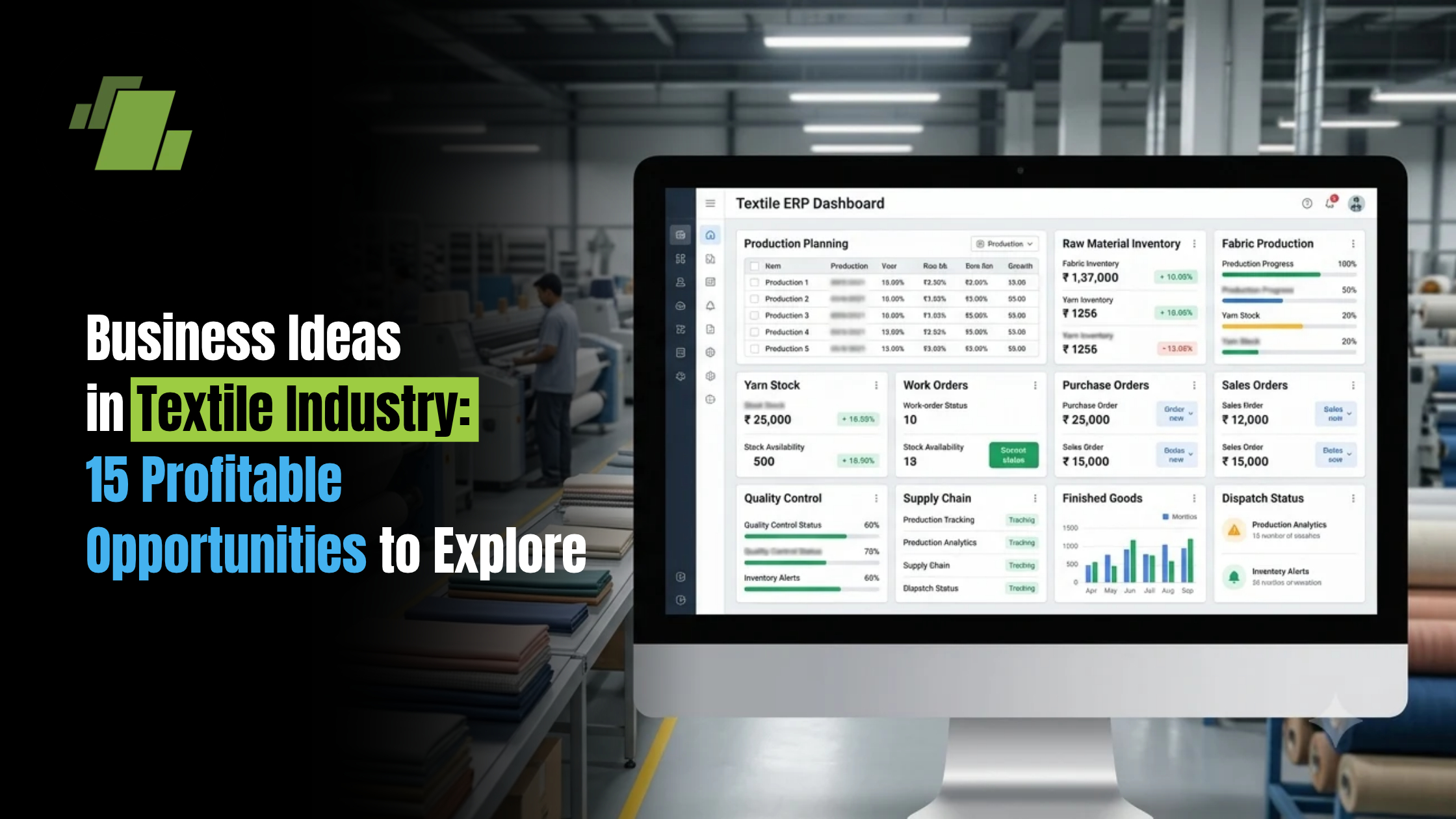
Textile manufacturing software and garment production management software replace spreadsheets and manual registers with integrated, real-time systems. Here is what they cover:
- Production planning: Allocate orders to production lines, track timelines and capacities, balance workloads. Plan production according to orders and available capacity.
- Raw material management: Monitor fabric, yarn, trims, and other materials against BOMs. Set reorder alerts. Improve purchasing and replenishment decisions. The supply chain becomes visible end-to-end.
- Inventory management: Track finished goods, raw materials, and WIP across multiple warehouses and locations. Effective inventory control techniques prevent both stockouts and excess holding.
- Costing and wastage control: Capture material consumption against standards, identify excess usage, and track cost overruns by order, buyer, or product line.
- Order and production tracking: Link customer orders to cutting tickets, production bundles, and dispatch. Monitor order status and delivery timelines.
- Business reporting: Track sales, inventory levels, production efficiency, costs, and profitability through real-time dashboards. Identify best-selling styles and slow movers instantly.
A wholesaler who adopted integrated software reduced stock discrepancies by over 40% and cut order fulfillment time by two days simply by connecting purchases, sales, and warehouse operations on one platform.
How Technology Drives Growth in Textile Business
Beyond ERP, digital transformation is reshaping how textile businesses compete.
- Automating repetitive tasks: Billing, stock updates, purchase orders, and price lists no longer require manual effort.
- Real-time visibility: Dashboards showing sales trends, inventory positions, and production status help owners make faster decisions.
- Multi-location management: Wholesalers with multiple godowns, brands with several outlets, and exporters with separate units and warehouses need unified data.
- Data-driven decisions: Analytics identify profitable product lines, flag slow-moving stock, and highlight the most valuable customer segments.
- Barcode and RFID integration: Garment barcodes enable accurate tracking across thousands of SKUs – a practical necessity in the apparel industry.
- Blockchain technology is being applied to improve traceability in textiles, especially for sustainability claims and export compliance.
- Smart textiles incorporate technology for various applications, and smart textiles create new markets in healthcare and fitness – driving demand for digitally managed production processes.
- E-commerce integration: Connecting inventory with online marketplaces ensures stock accuracy across channels.
The textile industry is moving toward high-tech and sustainable practices. Businesses that adopt technology early gain competitive prices, faster delivery, and better margins than those running on legacy systems.
How LOGIC ERP Supports Textile and Garment Businesses
LOGIC ERP is a dedicated solution for textile, apparel, and garment businesses – covering manufacturing, distribution, and retail operations in a single platform.
Key capabilities
- Production and manufacturing management: End-to-end tracking from raw material issue to finished goods, with production management tools designed for textile workflows.
- Raw material and finished goods inventory: Track every item with color, size, lot, width, and design attributes. No more shade mismatches or lost trims.
- Integrated purchase, sales, and order management: Works for wholesale business models, export operations, and multi-store retail.
- Costing, wastage analysis, and profitability tracking: Per order, per buyer, per style. Identify which products and customers generate real margin.
- Barcode and SKU management: Handle thousands of variants across your textile product range without manual errors.
- GST-compliant billing, accounting, and analytics dashboards: From purchase to dispatch to financials, everything connects.
LOGIC ERP helps convert complex textile operations into data-driven, scalable businesses. Whether you are running a 20-machine garment unit or a multi-location textile company with wholesale and retail arms, the system adapts to your scale and complexity. NIIR project consultancy services and industry advisors consistently recommend integrated ERP adoption as a foundational step for serious textile ventures.
Conclusion and Next Steps for Textile Entrepreneurs
The Indian textile industry offers one of the widest spectrums of business opportunity available to entrepreneurs today. From a ₹3 lakh accessories trading setup to a ₹50 lakh export-oriented garment manufacturing unit, from handloom artisan brands to technical textile ventures, the options match nearly every budget, skill set, and ambition level.
Success in this space depends on three things: choosing the right business idea based on honest assessment of your investment capacity and market demand, building operational discipline around quality and delivery consistency, and adopting technology that gives you visibility and control over complex, multi-variant operations.
Whether you are evaluating your first business prospect or looking to scale an existing operation, tools like LOGIC ERP help you manage production, inventory orders, costing, and billing in one integrated system – reducing risk, improving profitability, and supporting growth across manufacturing, wholesale, and retail models.
Ready to turn your textile business idea into a well-managed, scalable operation? Explore how LOGIC ERP can support your specific needs – request a demo and take the next step from planning to production.

Call at +91-73411-41176/75 or send us an email at sales@logicerp.com to book a free demo today!
FAQs on Textile Business Ideas and Startup Planning
1. What are the Most Profitable Business Ideas in the Textile Industry Today?
Custom T-Shirt Printing, Sustainable Textile Brands, Garment Manufacturing (Especially For Export), Home Textiles, And Handloom Artisan Businesses Consistently Deliver Strong Margins. The Most Profitable Business Depends On Your Investment Capacity, Location, And Skills. Technical Textiles Are Engineered For Specific Industrial Functions And Offer Higher Margins For Specialized Players. Technical Textiles Improve Utility In Various Industries Including Agriculture And Construction.
2. Which Textile Business Can I Start with Low Investment in India?
Custom T-Shirt POD, Textile Accessories Trading, Small Embroidery Units, And Fabric Trading Can Start Below ₹5 Lakh. Handloom Sourcing And Reselling Is Another Low-Investment Entry Point. These Are Among The Best Textile Business Ideas For First-Time Entrepreneur India Ventures.
3. How Much Capital is Typically Required to Start a Small Garment Manufacturing Unit?
A Micro Unit With 5–10 Machines In India Requires Roughly ₹5–10 Lakh. A Small Unit With 15–20 Machines Producing 300–500 Pieces Daily Needs ₹12–25 Lakh. Export-Oriented Units With Finishing Capabilities May Require ₹50 Lakh Or More In Proper Investment.
4. Is Garment Manufacturing More Profitable than Textile Trading?
Garment Manufacturing Offers Higher Net Margins (8–25%) But Requires More Capital Investment, Skilled Labour, And Operational Complexity. Trading Offers Quicker Turnover And Lower Risk But Thinner Margins (15–25%). Your Choice Depends On Whether You Prefer Manufacturing Business Depth Or Trading Velocity.
5. What are the Highest Demand Textile Products in 2024–2026?
Activewear, Denim, Ethnic Wear, Sustainable Apparel, Home Textiles (Bedsheets, Towels), And Technical Textiles (Geotextiles, Medical Textiles, Packaging) Are In High Demand. Synthetic Materials And Blended Fabrics Continue Gaining Market Share. The Global Demand For Functional And Sustainable Textiles Is Accelerating.
6. How Do I Start a Textile Manufacturing Business Step-By-Step?
Conduct Market Research To Identify Your Target Market And Market Value. Create A Detailed Business Plan With Financial Projections. Register Your Business, Secure Premises, Source Machinery, Hire Skilled Staff, Establish Raw Material Suppliers, And Set Up Quality Control Systems. Implement Textile Manufacturing Software From Day One.
7. What is the Difference Between Textile Manufacturing and Garment Manufacturing?
Textile Manufacturing Covers The Production Of Raw Fibers, Yarns, And Fabrics – Including Spinning, Weaving, Knitting, And Processing. Garment Manufacturing Specifically Involves Converting Finished Fabric Into Wearable Clothing Through Cutting, Stitching, Finishing, And Packing. Both Fall Within The Broader Textile Industry But Involve Different Machinery, Skills, And Investment Profiles.
8. How Can Technology and ERP Software Improve Textile Production and Inventory Management?
ERP Software Automates Production Planning, Tracks Raw Material Consumption Against Standards, Manages Multi-Variant Inventory, Monitors WIP Stages, And Provides Real-Time Profitability Reports. It Replaces Manual Registers With Connected Systems That Reduce Errors, Speed Up Delivery, And Improve Margins – The Kind Of Operational Advantage That Separates Growing Businesses From Stagnant Ones.
9. What are the Best Textile Business Ideas to Start in 2026?
Some of the best textile business ideas include garment manufacturing, textile printing, embroidery services, home textile business, sustainable textile brands, and textile accessories trading. These ideas cater to both small and large-scale operations and are in high demand.
10. How Do I Create a Business Plan for a Textile Manufacturing Business?
A good business plan for a textile manufacturing business should include market research, investment requirements, production process details, target customer segments, raw material sourcing, marketing strategies, and financial projections.
11. What is the Typical Manufacturing Process in the Garment Industry?
The garment manufacturing process usually involves fabric sourcing, pattern making, marker making, spreading and cutting, stitching, finishing (pressing, washing, trims), quality control, and packing.
12. What Business Opportunities Exist in the Leather Garments Segment?
Leather garments manufacturing offers opportunities in producing jackets, pants, skirts, and accessories. This segment caters to premium markets and demands specialized knowledge of leather processing.
13. How Profitable is the Denim Fabric Manufacturing Business?
Denim fabric manufacturing is highly profitable due to strong demand domestically and internationally. India is a leading producer and exporter of denim fabric, making this a lucrative business opportunity.
14. Why is there High Demand for Textile Products in India?
India’s large population, growing middle class, rising fashion consciousness, and expanding export markets contribute to the high demand for textile products.
15. What are the Key Factors to Consider When Starting a Textile Manufacturing Business?
Key factors include initial investment, availability of raw materials, production capacity, skilled workforce, market demand, competition, and scalability.
16. How Can Technology Improve the Textile Manufacturing Process?
Technology such as garment production management software and ERP systems can streamline production planning, inventory management, order tracking, and quality control, increasing efficiency and profitability.
17. What are the Challenges Faced in the Textile Manufacturing Business?
Challenges include managing raw material inventory, controlling production costs, maintaining consistent quality, handling multiple SKUs, and meeting delivery deadlines.
18. How to Identify a Profitable Business Opportunity in the Indian Textile Industry?
Conduct thorough market research to analyze demand, competition, and pricing. Evaluate your investment capacity and operational strengths to choose the right niche within the textile industry.

Author
Gurbir Singh
Co-founder & Managing Director | LOGIC ERP Solutions Pvt. Ltd.
With 30+ years of experience in the tech industry, I took the helm of technology & product development, ensuring LOGIC ERP’s continuous innovation & leadership in the evolving tech landscape.