From ERP, MRP, and MES to BOM, OEE, and shop floor control — each term includes a concise definition, why it matters in 2026, and a "what to ask your vendor" angle you can use when evaluating any manufacturing ERP system.
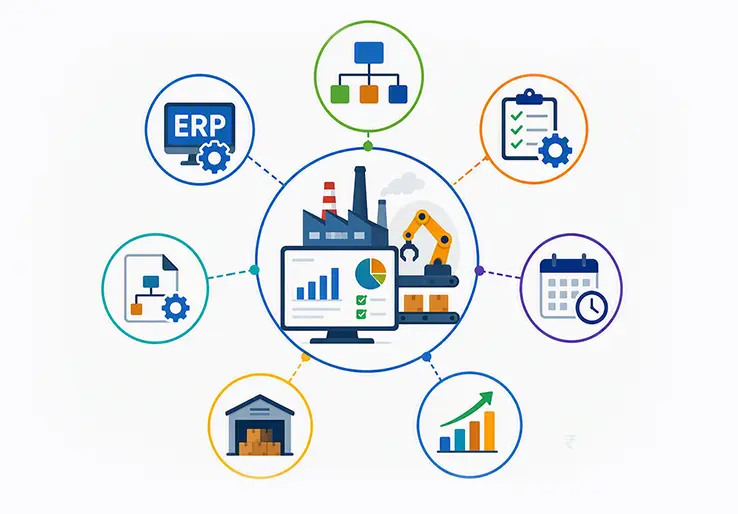
The manufacturing industry in 2026 runs on data, automation, and integrated systems. Whether you are evaluating an ERP solution for the first time or upgrading a legacy setup, the terminology you encounter in vendor demos, RFPs, contracts, and even AI-powered search results can make or break your decision-making.
Manufacturing software uses terms like ERP, MRP, and MES to connect factory floors with businesses. If you do not understand these terms, you risk misreading vendor capabilities, overpaying for features you do not need, or missing critical gaps in your production strategy. LOGIC ERP uses all of these terms across its platform, documentation, and implementation projects, so getting fluent now saves you time and money later.
This article is your practical manufacturing glossary. Each term includes a concise definition, why it matters in 2026, and a "what to ask your vendor" angle you can use when evaluating LOGIC ERP or any competing ERP system. Let us get started.
Enterprise resource planning is the central management software suite that integrates finance, production, inventory, sales, purchasing, and quality into a single database and workflow engine. It is the backbone of every manufacturing business that wants a unified view of its operations.
ERP systems integrate multiple business functions into one platform, providing a single source of truth for businesses. They provide a unified view of information across systems, enable manufacturers to manage asset utilization and control costs, and can automate routine tasks across the organization. Manufacturing ERP systems provide real-time data for informed decision-making at every level — from the shop floor to the boardroom.
The numbers tell the story clearly:
LOGIC ERP fits squarely into this definition with dedicated manufacturing modules rather than generic accounting software rebranded for factories. When evaluating any ERP system, ask: which modules are built-in versus bolt-on? How does AI assist in forecasting and anomaly detection? What deployment models are supported?
Material requirements planning is the engine inside manufacturing ERP software that calculates what raw materials are needed, in what quantities, and when — based on current inventory, planned orders, and lead times. MRP systems focus on materials needed for production scheduling, eliminating guesswork from procurement.
The master production schedule is the high-level, time-phased plan of what finished goods will be produced, by date and quantity. It answers: "What are we making, how many, and when?"
MRP and the master production schedule work together to prevent stockouts, reduce overtime, and keep machines running. Manufacturing ERP systems include features for production planning and quality control that depend entirely on accurate MRP and MPS data.
What to ask your vendor: How does BOM versioning interact with MRP? Can the system run what-if scenarios for supplier delays or alternate BOMs? How configurable are time buckets and planning horizons?
A manufacturing execution system is the shop floor level software system that tracks work orders, machine status, labor, scrap, and quality gates in real time. MES software monitors production in real time on the shop floor, bridging the gap between planning (ERP) and physical execution.
The relationship is straightforward: ERP plans and accounts; MES executes and reports. They must exchange data seamlessly. SFC modules track and analyze work orders and labor efficiency on the manufacturing floor, feeding actuals back to ERP for costing, variance analysis, and demand forecasting.
Many mid-sized manufacturers run MES features as embedded modules inside their ERP rather than purchasing a separate product. LOGIC ERP integrates with MES-style data capture — tablets, barcode scanners, IoT devices — to give production managers a live view of manufacturing operations.
What to ask your vendor: What is the resolution of data capture (seconds, minutes, operator input, machine signals)? How tight is the integration between ERP and MES, and which system is the record-keeper for which data?
A bill of materials is the complete, structured list of components, subassemblies, and raw materials needed to manufacture one finished product. It is the DNA of every manufactured item.
BOMs come in two main forms:
Version control is critical for regulated industries like pharma (FDA cGMP) and automotive (IATF 16949). BOM accuracy directly drives correct MRP calculations, production costing, quality management, and electronic data interchange with suppliers.
Simple multi-level BOM example:
Finished Product A
└─ Subassembly B
    ├─ Component C
    └─ Raw Material D
├─ Component E
└─ Raw Material F
LOGIC ERP supports engineering BOM vs production BOM separation, allowing R&D teams and production teams to work from the right version at each stage.
A routing is the defined sequence of operations required to produce a part. A work center is the machine, production line, or labor group that performs each operation. Production capacity is the available production time per work center — hours per shift per day — and accurate capacity data is essential for realistic production schedules.
Manufacturing software uses routings and work centers alongside MRP and the master production schedule to generate feasible production plans that account for bottlenecks and constraints.
Routing example inside LOGIC ERP for a metal bracket:
| Operation | Work Center | Setup Time | Run Time/Unit |
|---|---|---|---|
| 1. Laser Cut | WC-1 | 0.5 hrs | 0.01 hrs |
| 2. Drill | WC-2 | 0.3 hrs | 0.008 hrs |
| 3. Deburr & Polish | WC-3 | 0.2 hrs | 0.012 hrs |
| 4. QC Inspection | WC-4 | 0.1 hrs | 0.005 hrs |
What to ask your vendor: Can you define shift schedules, holidays, and planned maintenance downtime per work center? Does the system support alternate work centers and bottleneck identification? Does routing data feed into constraint-based scheduling?
Different ERP vendors use different labels — work order, production order, job ticket — but the concept is the same. These documents authorize production, reserve materials from inventory, and assign labor and machine time to a specific quantity of a product.
A work order lifecycle typically follows this path:
from a sales order, forecast, or the master production schedule
to the shop floor with material reservations.
with labor and machine time recorded.
with actual quantities, scrap, and rework logged.
with costs calculated and posted to financial reporting.
ERP systems help manufacturers deliver products on time with minimal errors by tracking every stage of this lifecycle. LOGIC ERP generates work orders directly from sales orders, demand forecasting outputs, or the master production schedule, ensuring no production run starts without proper authorization and material availability.
Every manufacturing ERP system must track three core inventory categories:
Manufacturers also use different production strategies that directly affect how inventory is planned and managed:
Each type must be tracked separately for financial reporting, costing, and quality management. Manufacturing ERP systems can reduce carrying costs by optimizing inventory levels across all three categories. ERP systems provide end-to-end inventory control for manufacturers, improving visibility across the entire manufacturing process.
For industries with traceability requirements, batch and lot tracking and serial number tracking are non-negotiable in 2026. LOGIC ERP uses a unified item master to manage inventory across all types with location-wise and bin-wise visibility, helping you manage inventory accurately across multiple warehouses.
A quality management system in manufacturing ERP covers inspections, test plans, control plans, nonconformance handling, and corrective actions (often called CAPA — Corrective and Preventive Action). WMS and QMS are often integrated with ERP systems for seamless traceability.
A nonconformance is any deviation from specification — a raw material that fails incoming inspection, a product that does not meet tolerance, or a process that drifts outside standard operating procedures. Modern ERP captures, analyzes, and closes these events with full audit trails.
Common 2026 regulatory frameworks driving QMS requirements in ERP:
LOGIC ERP links quality records to batches, suppliers, and customers, enabling rapid root-cause analysis and recall management when equipment failures or material defects surface.
OEE measures manufacturing productivity as a combination of availability, performance, and quality. The formula:
Calculation example:
| Component | Calculation | Result |
|---|---|---|
| Availability | 432 min run ÷ 480 min scheduled | 90% |
| Performance | 550 units actual ÷ 600 units ideal | 91.7% |
| Quality (First-Pass Yield) | 520 good ÷ 550 produced | 94.5% |
| OEE | 0.90 × 0.917 × 0.945 | 78% |
Beyond OEE, manufacturers expect modern manufacturing software to track these key performance indicator metrics: on-time delivery, first-pass yield, production capacity utilization, and scrap rate.
ERP systems enhance operational efficiency by automating routine tasks and surfacing these KPIs on role-based dashboards. Operational visibility allows managers to monitor shop-floor performance in real-time, while data-driven decision making shifts maintenance from reactive to predictive. LOGIC ERP surfaces these metrics for plant heads, finance teams, and supply chain managers with AI-based data analysis that suggests specific improvements.
Supply chain management is the coordination of suppliers, manufacturers, logistics partners, and customers across the entire value chain. SCM software manages the flow of goods from suppliers to customers, covering purchasing, vendor rating, lead time management, inbound logistics, and distribution planning.
The disruptions of 2020–2026 — pandemics, geopolitical shifts, raw material shortages — have made integrated supply chain visibility non-negotiable. Over 82% of manufacturing leaders now identify AI as critical to growth, and much of that investment flows into supply chain operations and demand forecasting capabilities.
LOGIC ERP enables planners to simulate supplier delays, evaluate alternate suppliers, and adjust safety stock strategies before disruptions hit production. When your supply chain software is integrated with MRP, financials, and quality control, you can respond to changes in customer demand within hours rather than weeks.
What to ask your vendor: How does the system handle multi-supplier sourcing for a single component? Can planners run scenario-based simulations? How are vendor ratings calculated and surfaced?
Electronic data interchange is the standardized, computer-to-computer exchange of business documents — purchase orders, invoices, advance shipping notices — between business partners. It is a business to business integration standard that removes manual data entry and speeds up supply chain operations.
Automotive, retail, and export-focused manufacturers use EDI to comply with large customer requirements. Common standards include EDIFACT and ANSI X12. In 2026, modern systems blend EDI with API-based integrations for greater flexibility.
LOGIC ERP integrates with EDI gateways to automate order capture, shipping confirmations, and accounts payable matching, cutting transaction processing time significantly and reducing errors in financial transactions.
Customer relationship management software manages leads, opportunities, quotes, and customer service interactions. In 2026, manufacturers increasingly need CRM integrated with ERP to handle long sales cycles, aftermarket service, and repeat orders — building stronger customer relationships over time.
CRM data — forecasts, quotes, won deals — feeds directly into demand planning and the master production schedule, enabling the production team to meet customer demand based on real sales data rather than guesswork. CPQ software helps generate quotes for configurable and custom products, an increasingly common requirement in discrete manufacturing.
LOGIC ERP's CRM integration gives sales and production teams a single shared view of the customer pipeline, so manufacturing operations can adjust production capacity before orders even land.
Manufacturing ERP connects operational data to finance modules, tying every production run to your general ledger. Key concepts include:
Accounts payable tracks what you owe suppliers; accounts receivable tracks what customers owe you. Together they drive cash flow visibility, vendor terms management, and credit control. Manufacturing accounting differs from simple retail accounting software because production costs must flow through WIP, absorb overheads, and reconcile with physical inventory.
Manufacturers should assess total cost of ownership before implementation — not just licensing, but hosting, customization, training, and ongoing maintenance. LOGIC ERP automates 3-way matching (PO, GRN, invoice) and integrates production costs directly into financial reporting, giving your finance team accurate margin visibility by product, order, or customer.
Data migration is the process of moving master data and transaction history from legacy systems or spreadsheets into a new ERP. It is one of the most underestimated phases of any ERP project. Poor integration is a leading cause of ERP implementation failure, and dirty data will undermine everything from MRP calculations to business intelligence reports.
Key implementation terms buyers encounter in 2026:
The median ERP project cost is $450,000, and the main data sets manufacturers must plan for include: item master, BOMs, routings, opening stock, open POs, open SOs, vendor and customer masters.
LOGIC ERP projects typically phase data migration to reduce risk — master data first, then open transactions, then limited history. Ask your software provider: what cleansing and validation tools are included? What is the typical timeline for mid-sized manufacturers?
ERP deployment options include cloud, on-premises, two-tier, and hybrid, each with distinct trade-offs for manufacturers.
| Deployment Model | Key Advantage | Key Consideration |
|---|---|---|
| Cloud ERP (SaaS) | Scalability, lower upfront cost, rapid updates | Data sovereignty, latency for shop-floor devices |
| On-premises | Greatest level of control over data and infrastructure | Higher capital expenditure, IT staffing requirements |
| Hybrid | Core ERP in cloud, plant-level components on-prem | Complexity in integration and maintenance |
| Two-tier | Supports controlled migration to cloud systems | Requires clear system-of-record boundaries |
Cloud ERP is the most popular deployment method today, and cloud based software adoption in manufacturing continues to accelerate. On-premises ERP allows for the greatest level of control, which matters for companies with strict regulatory or cybersecurity requirements. Hybrid ERP combines on-premises and cloud-based deployment, and two-tier ERP supports controlled migration to cloud systems for organizations transitioning gradually.
LOGIC ERP supports cloud, on-premises, and hybrid deployments, making it flexible for single-plant operations and scalable for multi-plant, multi-location manufacturing businesses.
Production costing, management, planning, and scheduling are foundational elements in manufacturing ERP systems that ensure efficient use of resources, timely product delivery, and cost control throughout the manufacturing process.
Shop floor management refers to the oversight and coordination of all activities occurring on the manufacturing floor. It involves managing labor, machines, materials, and workflows to maximize productivity and maintain quality standards. Shop floor control (SFC) is the operational component that tracks and manages the execution of production orders in real time. SFC systems capture data on work order status, labor hours, machine utilization, scrap, and rework, providing immediate feedback to managers.
Modern ERP solutions integrate shop floor control with higher-level planning and financial systems to create a seamless flow of information from the factory floor to executive dashboards. This integration enhances operational visibility, enabling rapid response to bottlenecks, downtime, or quality issues.
Quality control (QC) within manufacturing ERP ensures products meet defined specifications and regulatory standards. QC processes include inspections, testing, sampling, and nonconformance management. ERP systems facilitate quality control by automating inspection scheduling, recording test results, and triggering corrective actions when deviations occur.
In 2026, quality control is tightly integrated with other ERP modules such as production, inventory, and supplier management to enable end-to-end traceability and continuous improvement. Advanced ERP platforms also leverage AI and machine learning to predict quality issues before they arise, reducing scrap and rework costs.
Work order management in manufacturing ERP involves creating, scheduling, and tracking production orders that authorize the manufacture of specific quantities of products. Effective work order management ensures materials and labor are allocated efficiently, production timelines are met, and costs are accurately captured.
Machine maintenance is critical to minimizing unplanned downtime and extending equipment life. ERP systems support preventive and predictive maintenance by scheduling routine upkeep based on machine usage data and condition monitoring. Integration between maintenance and production modules allows for planned downtime coordination, reducing disruptions to the manufacturing schedule.
Manufacturing ERP must accommodate different production types:
By supporting these manufacturing modes, ERP software empowers businesses to streamline operations, reduce operational costs, and improve product quality across the entire factory floor.
What to ask your vendor: How does the ERP system integrate shop floor control with production planning and financials? Does it support real-time quality monitoring and automated corrective actions? Can the system handle both process and discrete manufacturing with configurable workflows? What predictive maintenance capabilities are included to reduce machine downtime?
This article forms a practical manufacturing glossary of the most critical ERP and manufacturing software terms for 2026. Together, they cover every layer of the manufacturing process — from high-level business strategy and financial management to shop floor execution, risk management, and project management.
How to put this glossary to work:
Manufacturing ERP enables manufacturers to run leaner, smarter, and more resilient operations. The right manufacturing software paired with the right terminology knowledge puts you in control of every conversation — from the first demo to post-go-live optimization using lean manufacturing methodology and business intelligence dashboards.
Understanding these terms is the first step. The next step is seeing how they come to life inside a system built for your industry.
Ready to see these terms in action? Explore LOGIC ERP's manufacturing modules or talk to a LOGIC ERP consultant about mapping these concepts to your current production processes and business strategy. The best manufacturing software decision starts with the right questions — and now you have them.
Call at +91-73411-41176 / +91-73411-41175 or send us an email at sales@logicerp.com to book a free demo today!
Materials management involves planning, organizing, and controlling the flow of materials from procurement through production to finished goods. It ensures the right materials are available at the right time, minimizing inventory costs and production delays. Efficient materials management is a core function of manufacturing ERP systems, helping optimize stock levels and reduce carrying costs.
Human Machine Interface (HMI) refers to the user interface that connects operators to machines and production equipment. It allows real-time monitoring, control, and data input on the shop floor. Modern manufacturing ERP systems often integrate HMI data to provide operational visibility and support predictive maintenance.
Software tools encompass the various modules and applications within an ERP system that manage different manufacturing functions such as inventory, production scheduling, quality control, and financials. These tools automate routine tasks, enhance data accuracy, and enable data-driven decision-making across the enterprise.
Inventory tracking is the process of monitoring raw materials, work-in-progress, and finished goods throughout the supply chain and production cycle. Manufacturing ERP systems provide real-time inventory visibility, location tracking, batch and serial number control, and automated alerts to prevent stockouts or overstock situations.
Inventory management refers to the strategic oversight of inventory levels, procurement, storage, and distribution. ERP-enabled inventory management optimizes stock levels, reduces waste, and ensures materials are available for production without incurring excessive carrying costs.
Computer Controlled Machinery uses programmable logic controllers (PLCs), CNC machines, and robotics to automate manufacturing processes. Integration of these machines with ERP systems through IoT and HMI interfaces allows real-time data capture and improved operational efficiency.
A Warehouse Management System (WMS) is a software module or standalone system that manages warehouse operations including receiving, put-away, picking, packing, and shipping. WMS integrated with ERP provides seamless inventory control and enhances supply chain efficiency.
Entire business integration refers to the ERP system's capability to unify all core business processes — finance, manufacturing, supply chain, sales, and HR — into a single platform. This integration eliminates data silos, improves collaboration, and provides a single source of truth for decision-making.
Enterprise Resource Planning (ERP) software is a comprehensive suite that integrates multiple business functions into one system, facilitating data sharing and process automation. In manufacturing, ERP connects production, inventory, quality, financials, and customer management to optimize operations and improve efficiency.
Core business processes include procurement, production planning, inventory management, order fulfillment, quality control, financial accounting, and human resources. Manufacturing ERP systems coordinate these processes to enhance operational visibility, reduce costs, and improve customer satisfaction.
Manufacturing software terms are the specialized vocabulary used to describe systems, processes, and functions within manufacturing ERP and related software. Understanding these terms helps manufacturers make informed decisions about software selection, implementation, and optimization.
The manufacturing industry comprises businesses engaged in producing goods using raw materials, labor, and machinery. ERP systems tailored for manufacturing address unique challenges such as production scheduling, quality compliance, inventory control, and supply chain management.
The best manufacturing software depends on business size, complexity, and industry needs. Leading ERP systems like LOGIC ERP offer integrated modules for production, inventory, quality, and finance with scalable deployment options. Evaluating vendor capabilities, integration, and support is critical to selecting the right software.
Management software in manufacturing refers to digital solutions that oversee production operations, resource planning, quality assurance, and business analytics. ERP systems are a primary example, providing end-to-end management of manufacturing workflows and data.
A manufacturing glossary is a comprehensive list of terms and definitions related to manufacturing processes, software, and industry standards. It serves as a reference to help professionals understand technical language and communicate effectively across teams and vendors.
Popular Products