Grocery Store Operations: A Complete Guide to Purchasing, Inventory, Billing and Store Management

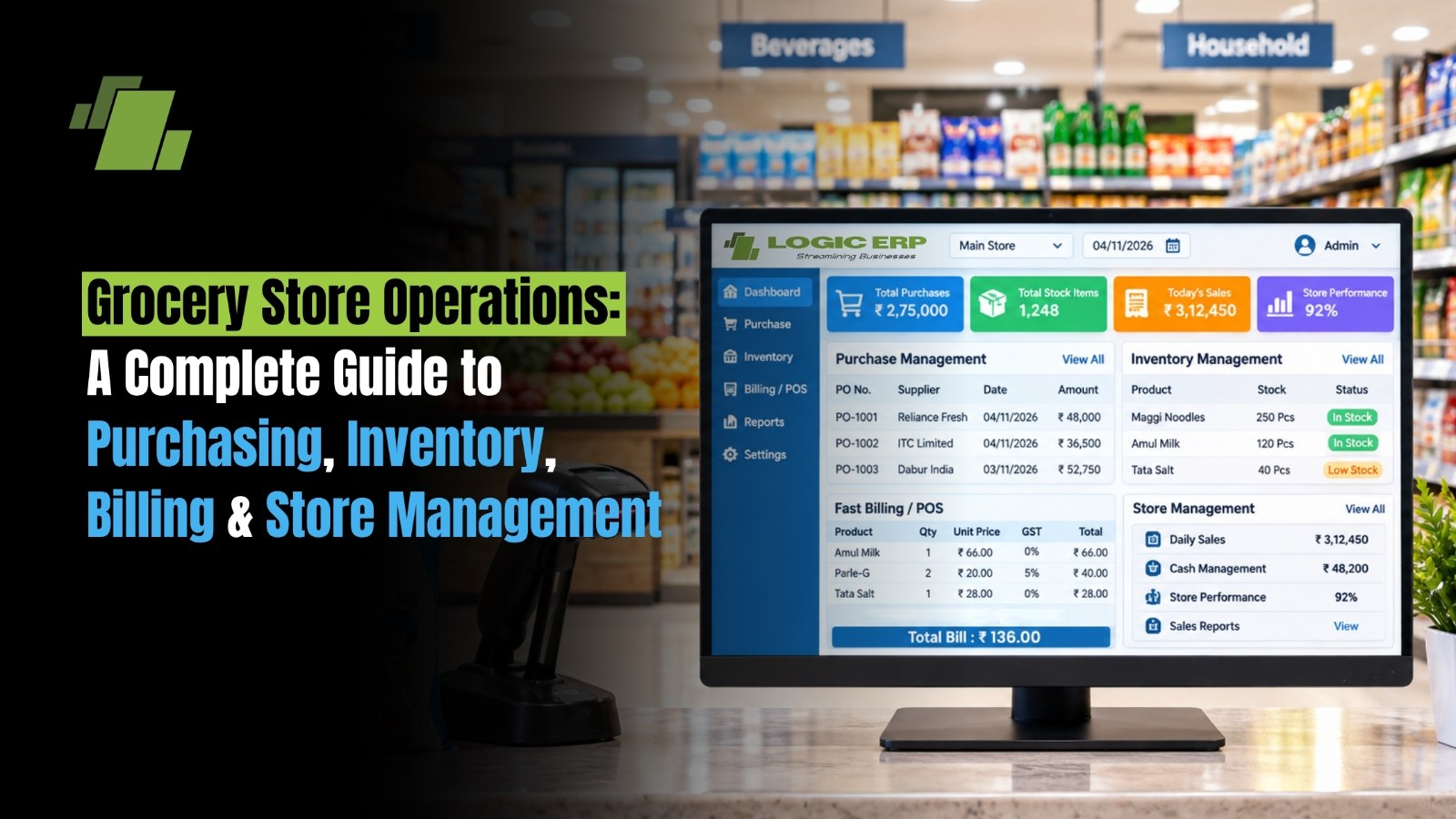
Modern grocery and supermarket retail is a high-volume, low-margin business. Managing a successful store requires executing tightly synchronized core functions: procurement, inventory management, point-of-sale (POS) billing, and day-to-day store operations.
A minor leak in stock control- whether from perishable spoilage, inaccurate billing, vendor short-shipments, or theft-can instantly wipe out thin operating margins.
This guide breaks down end-to-end grocery store operations, offering actionable frameworks, step-by-step processes, mathematical formulas, operational checklists, and scalable technology strategies for retail success.
Contact Us
Free Demo Request
1. Grocery Store Purchasing & Procurement Management
Procurement sets the foundation for inventory velocity, shelf availability, and profit margins. Grocery procurement involves balancing demand, supplier reliability, seasonal spikes, and cash flow.
Strategic Vendor Management
Managing multiple vendors (FMCG distributors, local farmers, dairy suppliers, and direct-to-store delivery (DSD) vendors) requires a centralized Vendor Master Database. Store operators should maintain digital profiles detailing:
-
Minimum Order Quantities (MOQs) and minimum order values (MOVs).
-
Supplier Lead Times: The exact days elapsed between PO creation and dock receipt.
-
Vendor Rate Contracts: Dynamic price locks linked to volume slabs and promotional allowances.
-
Payment Terms: Net-15, Net-30, cash-on-delivery (COD), or consignment structures.
Demand Forecasting & Order Quantity Optimization
Relying on manual visual checks or manager intuition leads to two costly outcomes: stockouts on high-velocity SKUs or tied-up capital in slow-moving ambient stock. Grocery buyers rely on automated replenishment models:
Economic Order Quantity (EOQ) Formula
To calculate the optimal quantity of a product to order to minimize total holding and ordering costs:
EOQ=2DSH
Where:
-
D = Annual demand (in units)
-
S = Ordering cost per purchase order (administrative, handling, transport)
-
H = Annual holding/carrying cost per unit (storage, insurance, capital cost, depreciation)
Reorder Point (ROP) Calculation
To ensure fresh stock arrives before shelf inventory runs out:
ROP = (Daily Usage Lead Time in Days) + Safety Stock
Example Calculation:
A supermarket sells an average of 50 units of organic milk daily (Daily Usage). The supplier takes 3 days to deliver an order (Lead Time). The store maintains a cushion of 30 units (Safety Stock) to cover weekend demand spikes.
ROP=(503)+30=180 units
When the system records the on-hand inventory hitting 180 units, a Purchase Order is automatically generated.
Receiving Dock Workflow & Goods Receipt Note (GRN) Processing
The warehouse dock or store receiving door is where inventory leakages frequently occur. Implementing a strict GRN process prevents short-shipments and invoice disputes:
-
Vehicle & Temperature Audit: Verify clean transport conditions and check cold-chain compliance for chilled/frozen items (e.g., dairy below 4°C, frozen below -18°C).
-
PO Verification: Match delivered items against the open Purchase Order (PO) to block unauthorized items or over-deliveries.
-
Barcode-Based Gate Entry & Item Count: Scan incoming cases using handheld terminal (HHT) scanners to log quantities against the PO.
-
Batch & Expiry Entry: Log manufacturing and expiry dates directly during receiving.
-
GRN Generation & Variance Alert: Generate the GRN. Automatically notify purchasing if delivered quantities or rates deviate from the agreed PO.
2. Inventory Control & Stock Management
Grocery inventory covers high-turnover FMCG goods, fragile produce, temperature-sensitive cold items, and bulk loose staples. Keeping inventory lean, fresh, and accurate requires structured control mechanisms.
Essential POS Hardware & Software Capabilities
Modern supermarket billing counters require hardware-software synchronization:
-
High-Speed Scanners & Multi-Barcode Support: Omnidirectional 2D barcode scanners capable of reading damaged, smudged, or compressed barcodes on flexible plastic packaging.
-
Weighing Scale Integration: Direct scale-to-POS integration to automatically transmit exact net weights for fresh produce and loose items, eliminating manual weight entry errors.
-
Touchscreen Interfaces & Custom Hotkeys: Quick-touch screen layouts for high-volume un-barcoded items (e.g., fresh cilantro, local bakery goods).
-
Hybrid Offline-First Architecture: POS nodes must maintain local databases to process transactions, scan items, and print receipts during internet outages. Data synchronizes automatically with the main store server once connectivity drops resolve.
Managing Customer Queues During Peak Hours
-
Queue-Busting Mobile POS: Deployment of handheld devices by store staff to pre-scan items while shoppers wait in line, generating a single master barcode for rapid payment scan at the main counter.
-
Self-Checkout (SCO) Kiosks: Dedicated stations for small-basket customers (under 10 items) integrated with scale verification.
-
Flexible Payment Gateway Integration: One-click digital payment processing via UPI, credit/debit cards, digital wallets, and loyalty point redemption.
3. Promotion & Discount Management Engine
To execute promotions without confusing checkout staff or slowing transaction speeds, modern billing software uses a centralized promotion engine:
-
Mix-and-Match Pricing: Buy 2 items from Category A + 1 item from Category B for a fixed bundle price.
-
Slab-Based Quantity Discounts: Buy 1 to 5 units at standard price; buy 6+ units for a 12% discount.
-
Threshold Loyalty Benefits: Instant cart value discounts (e.g., "₹500 off on purchases above ₹3,000") calculated at checkout.
4. Store Operations, Layout & Merchandising
Physical store space must be optimized to guide customer flow, increase dwell time, and maximize revenue per square foot.
Floor Plan Layout & Customer Flow Dynamics
-
Grid Layout Efficiency: Parallel aisles with clear sightlines allow customers to navigate efficiently while maximizing floor space utilization.
-
Decompression Zone: The first 5–15 feet inside the entrance where shoppers adjust to light and atmosphere. Avoid placing high-value merchandise here.
-
Perimeter Placement: Place high-frequency staple categories (dairy, fresh meat, bakery, produce) along the outer perimeter walls. This design forces shoppers to traverse outer aisles, exposing them to center-store impulse categories.
Category Management & Planograms
Planograms map visual product arrangements on store shelves to optimize visibility and sales:
Direct-Store-Delivery (DSD) & Cross-Docking Operations
-
Direct-Store-Delivery (DSD): High-turnover goods like soft drinks, bread, and chips bypass store distribution centers and are delivered directly by manufacturers to retail shelves. DSD receiving requires mobile electronic data interchange (EDI) scanning to prevent off-manifest items from entering stock.
-
Cross-Docking: Incoming inbound shipments are consolidated at the receiving bay and transferred directly to outgoing store trucks or immediate shelf staging without intermediate long-term warehouse storage.
5. Financial Management, Accounting & GST Compliance
Grocery operations handle large transaction volumes, requiring accounting controls to verify profitability and maintain tax compliance.
Key Financial Formulas for Grocery Retailers
Gross Margin Percentage
{Gross Margin %} = {Total Revenue - Cost of Goods Sold (COGS) / Total Revenue} X 100
Inventory Turnover Ratio (ITR)
Measures how many times inventory is sold and replaced over a period:
Inventory Turnover Ratio = Cost of Goods Sold (COGS) / Average Inventory Value at Cost
Where:
Average Inventory = Beginning Inventory + Ending Inventory /2
Sales Per Square Foot
Sales per Sq. Ft.= Net Annual Sales / Total Usable Store Retail Square Footage
GST & Multi-Tax Handling (Indian Retail Context)
Indian supermarket operations handle products spanning multiple GST slabs (0%, 5%, 12%, 18%, 28%) and non-GST items.
-
HSN Code Automation: Automatic mapping of Harmonized System of Nomenclature (HSN) codes to items during inventory creation.
-
Mixed Basket Tax Calculation: Correct handling of single transaction baskets containing tax-exempt fresh produce alongside 18% taxed personal care items.
-
GSTR-1 & GSTR-3B Reporting: Automated generation of sales returns, outward supplies summaries, and Input Tax Credit (ITC) tracking to prevent tax filing errors.
Cash Register & Tender Reconciliation
At the end of every cashier shift, perform Tender Reconciliation:
Variance = Physical Tender Count - (Opening Float+System POS Sales - Paid Outs)
Any negative variance must be flagged immediately to control cash handling discrepancies.
6. Staffing, Shift Scheduling & Store Security
Labor is one of the largest operating expenses in grocery retail. Workforce scheduling must match store foot traffic patterns.
Optimizing Store Workforces
-
Peak-Load Scheduling: Analyze hourly POS transaction counts to schedule staff during peak windows (typically 11:00 AM – 1:00 PM and 5:00 PM – 9:00 PM).
-
Cross-Functional Staff Training: Train floor staff to transition between shelf restocking, online order picking, and checkout line management during traffic spikes.
-
Role-Based POS Security Controls: Restrict cashier permissions to block unauthorized price overrides, manual item discounts, or line voids without manager approval.
Loss Prevention & Physical Security Protocol
-
CCTV Integration at High-Risk Zones: Position high-definition cameras over POS counters, receiving docks, exit doors, and high-value aisles (Class A stock).
-
Electronic Article Surveillance (EAS): Tag high-value items (liquor, cosmetics, premium oils) with anti-theft RF/AM tags deactivated only upon payment.
-
Bag Audits & Employee Lockers: Maintain clear security check-in protocols for floor personnel and third-party vendor delivery representatives.
7. Operational Challenges & Solutions
|
Operational Challenge |
Root Cause |
Impact on Business |
Practical Solution Strategy |
|
High Produce Spoilage |
Poor demand forecasting, improper cold storage, and non-compliance with FEFO. |
Direct margin loss, reduced store fresh food reputation. |
Implement dynamic batch tracking, day-level sales analytics, and automated progressive markdown schedules. |
|
Long Checkout Queues |
Slow POS scanning software, manual item searches, or un-barcoded items. |
Cart abandonment, lost sales, reduced customer retention. |
Deploy integrated weighing scales, HHT queue busters, and offline-first POS systems. |
|
Inventory Shrinkage & Loss |
Shoplifting, internal theft, supplier short-deliveries, unrecorded damages. |
Unexplained inventory variances, distorted financial statements. |
Mandate HHT barcode receiving against POs, set system user permissions, and perform weekly cycle counts. |
|
Stockouts on High-Turnover SKUs |
Delayed purchase orders, unreliable supplier lead times, lack of real-time inventory tracking. |
Lost sales, customer defection to competitors. |
Configure dynamic Reorder Points (ROP) with automated PO generation within an integrated ERP system. |
8. Digital Transformation: Omnichannel Grocery & Dark Store Models
Consumer expectations have expanded beyond traditional brick-and-mortar stores to include hyper-local delivery, click-and-collect, and WhatsApp ordering.
Integrating Brick-and-Mortar Stores with Online Fulfillment
-
Unified Stock Ledger: Maintain a single inventory database across physical stores, dark stores, and online stores. When an item sells in-store, its digital stock decrements instantly, preventing overselling on e-commerce channels.
-
HHT-Guided In-Store Picking: Store pickers receive orders on handheld mobile terminals that plot the shortest route through store aisles, reducing picking times for hyper-local fulfillment.
-
Dark Store Optimization: Dark stores function as fulfillment-only mini-warehouses in high-density residential zones. They replace customer display fixtures with high-density bin racking, organized specifically by picking velocity rather than visual merchandising.
9. Modernizing Operations with LOGIC ERP
Managing purchasing, high-speed billing, FEFO inventory tracking, and multi-channel fulfillment across single or multi-store retail chains through isolated manual systems creates operational silos.
LOGIC ERP brings these functions together into a single platform designed specifically for supermarket, grocery, and FMCG retail chains:
-
Integrated POS & Offline Resilience: Ensure fast billing with barcode scanning, scale integration, custom promotion management, and uninterrupted offline billing synchronization.
-
Automated Purchasing & Replenishment: Eliminate stockouts and manual purchase orders using reorder alerts and vendor ledger tracking.
-
Batch & Expiry Control (FEFO): Track product batches, monitor shelf-life windows, and execute automated price reductions to prevent spoilage write-offs.
-
Omnichannel Multi-Store Hub: Connect online shopping apps, physical store registers, and regional distribution centers through real-time inventory management.
-
Financial & GST Accounting: Simplify tax filings with automated HSN mapping, split-tender processing, GSTR compliance, and real-time P&L reporting.
Managing modern grocery store operations successfully requires balancing high customer transaction volumes with strict inventory accuracy and tight cost controls. By systematizing your core operational pillars - from implementing dynamic reorder points (ROP) in purchasing to executing FEFO stock rotation on the floor and accelerating checkout speeds with barcode and scale-integrated POS terminals - supermarkets can directly protect their bottom-line profitability against shrink, spoilage, and operational friction.
As grocery retail continues to blur the line between physical store management and hyper-local online fulfillment, relying on disconnected manual systems or standalone billing counters creates operational bottlenecks. LOGIC ERP resolves these silos by uniting procurement, batch-level inventory tracking, high-speed POS billing, multi-store warehousing, and GST-compliant accounting into a single, scalable enterprise software suite tailored for supermarket chains.
Ready to eliminate inventory leaks and streamline your store operations? Request a free live demo of LOGIC ERP today to discover how our grocery retail software can transform your grocery business efficiency.
Call at +91-73411-41176/75 or send us an email at sales@logicerp.com to book a free demo today!
Frequently Asked Questions
What is the Most Effective Inventory Rotation Method for Grocery Stores?
FEFO (First Expired, First Out) is the most effective method for perishable grocery items. It ensures that products with the earliest expiration dates are sold first, reducing spoilage write-offs. FIFO (First In, First Out) is used for non-perishable ambient items.
How do Supermarkets Calculate the Reorder Point (ROP)?
Reorder Point is calculated using the formula: ROP=(Daily UsageLead Time in Days)+Safety Stock. When inventory reaches this threshold, a purchase order is generated to prevent stockouts.
How does Offline POS Functionality Work During Internet Outages?
An offline-first POS system records sales, scans barcodes, and prints receipts locally during internet disruptions. Once internet connectivity is restored, transaction data automatically synchronizes with the main store server.
What is Retail Shrinkage and How can Grocery Stores Reduce it?
Retail shrinkage refers to inventory loss caused by shoplifting, employee theft, vendor fraud, administrative errors, or product spoilage. It can be controlled using barcode receiving audits, role-based POS permissions, FEFO rotation, and regular cycle counts.
What is the Difference Between Direct-Store-Delivery (DSD) and Cross-Docking?
DSD involves suppliers delivering products (like beverages or fresh bread) directly to store shelves, bypassing central warehouses. Cross-docking receives products at a distribution center dock and transfers them directly to store-bound trucks with minimal storage time.
How does Weighing Scale Integration Improve Supermarket Checkout Speed?
Integrated weighing scales send the exact weight of loose items directly to the POS system, calculating prices automatically. This speeds up checkout and eliminates manual weight entry errors.
Why is ABC-XYZ Analysis Important for Supermarket Stock Control?
ABC-XYZ analysis categorizes inventory by sales value (ABC) and demand predictability (XYZ). This helps store managers prioritize high-value Class A items for frequent counts while automating stock replenishment for predictable Class X goods.
How does an ERP System Simplify GST Compliance for Indian Supermarkets?
A retail ERP maps HSN codes to inventory, applies appropriate GST rates at checkout, and generates GSTR-1 and GSTR-3B tax summaries automatically.
What is Queue Bursting and How does it Benefit Grocery Stores?
Queue bursting uses handheld mobile POS units to pre-scan items for customers waiting in line. The cashier then scans a single master code at the main counter to process payment, reducing wait times during peak hours.
How can Grocery Chains Sync Online and In-Store Inventory?
A centralized ERP system maintains a single inventory database that updates stock levels in real time across online channels, physical counters, and dark stores.

Author
Gurbir Singh
Co-founder & Managing Director | LOGIC ERP Solutions Pvt. Ltd.
With 30+ years of experience in the tech industry, I took the helm of technology & product development, ensuring LOGIC ERP’s continuous innovation & leadership in the evolving tech landscape.

