Inventory Control Techniques for Better Stock Management

Summary
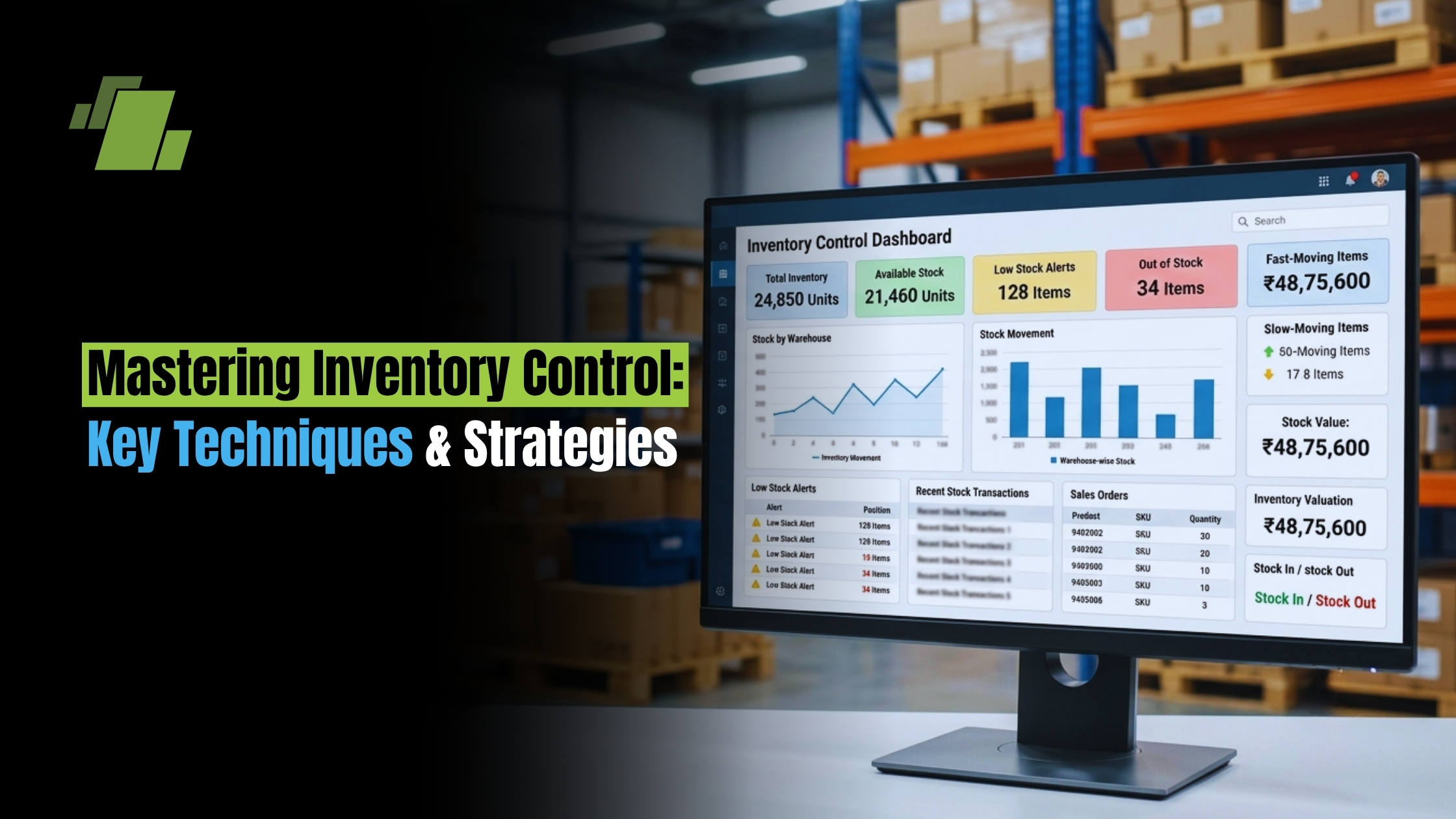
Good inventory control is all about knowing what you have, where it is, and when you need to replenish it. When stock is not managed properly, businesses can end up with too much inventory, frequent stockouts, unnecessary waste, or money tied up in products sitting on shelves. Techniques such as ABC analysis, reorder points, safety stock, FIFO, cycle counting, demand forecasting, and inventory automation help businesses keep stock under control. When these methods are supported by accurate data and the right inventory tools, businesses can reduce costs, improve order fulfillment, make better purchasing decisions, and keep day-to-day operations running smoothly.
Contact Us
Free Demo Request
Introduction
Managing inventory can become challenging as a business grows. More products, suppliers, warehouses, stores, and customer orders mean there is more to track and more chances for things to go wrong. A business may have plenty of stock but still struggle to find the right items, or it may run out of popular products while slow-moving stock continues to pile up.
This is where inventory control techniques come into play. Methods such as ABC analysis, reorder points, safety stock, FIFO, cycle counting, and demand forecasting give businesses a practical way to manage their inventory and make better decisions. These techniques help answer important questions like what needs the most attention, when to reorder, how much stock to keep, and how to avoid unnecessary inventory.
The goal of inventory control is not simply to keep stock as low as possible. It is about having the right products, in the right quantity, at the right time, while keeping costs and risks under control.
What inventory control means
Inventory control is the day-to-day work of knowing what stock you have, where it is, how fast it moves, and when to reorder it without tying up too much cash.
The right inventory control techniques help businesses cut waste, avoid stockouts, improve buying choices, and keep work running smoothly.
Whether you manage a store, warehouse, plant, or service team with parts and supplies, good stock control methods turn inventory into a system you can manage.
Which are the techniques of inventory control?
The main inventory control techniques include ABC analysis, just-in-time inventory, economic order quantity, safety stock planning, reorder points, cycle counting, demand forecasting, batch tracking, and inventory automation.
Each method answers a different question. What needs the most care? How much should we order? When should we reorder? How do we cut extra stock? How do we keep records right?
Used together, these various techniques of inventory control create a balanced plan that supports customer demand without filling the business with extra stock.
Good inventory control is not about holding as little stock as possible. It is about having the right stock, in the right amount, at the right time, with enough visibility to make clear choices.
That is why inventory control techniques in operations management are closely tied to purchasing, production planning, sales, finance, and customer service.
The business value of better inventory control
Inventory affects cash flow, storage space, labor planning, supplier ties, and customer satisfaction.
When stock levels are too high, money sits on shelves instead of being used elsewhere in the business.
When stock levels are too low, orders are late, production stops, and customers may choose another supplier.
Effective inventory optimization strategies help businesses find the middle ground.
They cut carrying costs while still protecting the company from demand spikes, supplier delays, and seasonal shifts.
They also make daily work easier because teams spend less time searching for items, fixing records, or handling emergency shortages.
A well-managed inventory system can support:
- More reliable order fulfillment because popular items are watched closely.
- Better purchasing decisions because buying is based on data, not habit.
- Lower waste and obsolescence because slow-moving stock is easier to spot.
- Improved cash flow because excess inventory is reduced over time.
- Stronger operations planning because teams can see what is on hand and what is at risk.
ABC analysis keeps attention where it matters most
ABC analysis is one of the best starting points because it groups inventory by value and risk.
Instead of treating every item the same, ABC analysis ranks products or materials by value to the business, often using annual usage value, sales value, or work impact.
A simple ABC structure looks like this:
- A items: High-value or high-impact items that need close watch, accurate forecasts, and tight control.
- B items: Mid-value items that need regular review but not the same level of attention as A items.
- C items: Low-value or low-impact items that can often be managed with simpler rules and less frequent review.
This method is useful because inventory teams rarely have unlimited time.
By focusing more effort on A items, the business can protect revenue, reduce risk, and avoid wasting management attention on low-priority stock.
For example, a manufacturer may watch a key machine part every day while checking low-cost packaging supplies less often.
ABC analysis also improves communication.
Finance teams can see where inventory value is concentrated, purchasing teams can negotiate more carefully for critical items, and operations teams can focus on stock accuracy where mistakes are most expensive.
Reorder points turn replenishment into a repeatable process
A reorder point tells the business when to place a new order before stock runs out.
It is usually based on average demand during supplier lead time, plus a buffer for uncertainty.
This makes replenishment steadier and lowers the risk of last-minute buying.
For example, if a business sells or uses 20 units a day and a supplier takes five days to deliver, it needs at least 100 units to cover normal demand during lead time.
If demand or delivery times change often, the business may add safety stock to protect against disruption.
The reorder point then becomes the trigger for action.
This approach works well for items with steady demand.
It also gives teams a clear rule to follow, which helps prevent both over-ordering and late ordering.
Reorder points should not be set once and forgotten, though.
They need regular review as demand patterns, lead times, supplier reliability, and product priorities change.
How do stock control methods reduce waste and shortages?
Stock control methods reduce waste and shortages by replacing reactive choices with planned inventory rules.
They help businesses spot fast-moving items, limit overbuying of slow-moving products, set minimum stock levels, and catch record errors before they hurt operations.
When these methods use accurate data, teams can act sooner and make smaller, smarter changes instead of waiting for urgent fixes.
Several methods are especially useful for day-to-day control:
- Cycle counting
Instead of stopping work for a full physical count, teams count selected items on a rotating schedule. High-value or fast-moving items can be counted more often, while lower-risk items are checked less often. - Safety stock planning
Safety stock acts as a buffer against unexpected demand or supply delays. The goal is not to stockpile, but to create a reasonable cushion for items where shortages would cause real disruption. - First in, first out control
Often called FIFO, this method helps older inventory move before newer inventory. It is especially important for perishable goods, dated materials, regulated products, or items that may become obsolete. - Minimum and maximum stock levels
Minimum levels help prevent stockouts, while maximum levels prevent overstocking. Together, they create guardrails for purchasing and warehouse teams. - Obsolete and slow-moving stock reviews
Regular reviews help identify products that are no longer selling, parts that are rarely used, or materials that may expire. This supports markdown, resale, return, or disposal decisions before the problem grows.
Forecasting connects inventory to real demand
Demand forecasting is one of the most useful inventory management tips for growing businesses.
It uses sales history, season, market trends, promotions, production schedules, and customer behavior to estimate future inventory needs.
Even a simple forecast is often better than relying only on instinct.
Forecasting works best when teams combine data with practical context.
A sales spike from a one-time promotion should not automatically become the new normal.
A product with strong seasonal demand may need earlier buying because supplier lead times can rise before the busy period.
A product with falling sales may need tighter buying rules to avoid excess stock.
Good forecasting also improves teamwork.
Sales can share upcoming campaigns, purchasing can confirm supplier capacity, operations can plan labor, and finance can prepare for cash needs.
The result is a more coordinated approach to inventory instead of separate teams working from different assumptions.
Inventory tracking solutions improve accuracy and visibility
Manual spreadsheets can work for very small operations, but they become harder to manage as item counts, locations, suppliers, and order volume grow.
Inventory tracking solutions and stock management tools help businesses see real-time or near-real-time stock levels, transaction history, item locations, and reorder alerts.
Common features to look for include:
- Barcode or QR code scanning to cut manual entry errors.
- Lot, batch, or serial number tracking so items can be traced.
- Multi-location visibility for warehouses, stores, vehicles, or job sites.
- Low-stock alerts based on reorder points.
- Reports for turnover, aging inventory, and stock value.
- Links with accounting, ecommerce, purchasing, or point-of-sale systems.
The best tool is not always the most complex one.
A small business may need a simple system that improves accuracy and saves time.
A larger operation may need advanced permissions, warehouse workflows, forecasting, and supplier management.
The key is choosing technology that matches the way the business actually works.
Supply chain techniques strengthen inventory planning
Inventory control does not happen inside the warehouse alone.
Supplier performance, shipping reliability, production capacity, and customer demand all affect stock levels.
That is why supply chain techniques are essential to stronger inventory planning.
Businesses can improve inventory control by checking supplier lead times, order minimums, delivery consistency, and communication quality.
If a supplier is reliable, the business may carry less safety stock.
If a supplier is erratic, the business may need stronger buffers, backup vendors, or earlier ordering triggers.
Useful supply chain practices include:
- Supplier scorecards to track delivery performance and quality issues.
- Vendor mix for critical items so one disruption does not stop operations.
- Lead time reviews to keep reorder points aligned with reality.
- Collaborative planning with key suppliers when demand changes are expected.
- Standardized purchasing processes so teams follow steady approval and ordering rules.
These practices make inventory control more resilient.
They also help businesses avoid blaming internal teams for problems that start with supplier delays, unclear purchasing rules, or weak demand sharing.
What should a business do before choosing stock management tools?
Before choosing stock management tools, a business should define its inventory problems, map its workflows, clean up item data, and decide which metrics matter most.
Software cannot fix unclear processes by itself, so it is important to know whether the main issue is inaccurate counts, late ordering, excess stock, weak forecasting, poor reporting, or limited visibility across locations.
A practical prep checklist includes:
- List the inventory locations that need to be tracked.
- Identify the items that create the most value, risk, or work pressure.
- Review current naming rules, units of measure, and product groups.
- Decide who can receive, adjust, transfer, and approve inventory.
- Document how purchase orders, sales orders, returns, and stock counts work today.
- Choose a few useful metrics, such as stockout frequency, inventory turnover, carrying cost, or order accuracy.
This groundwork makes implementation smoother.
It also helps teams avoid paying for features they will not use or choosing a system that cannot support their most important workflows.
Turning techniques into daily habits
To explain inventory control techniques clearly, it helps to separate the method from the habit.
ABC analysis is the method; reviewing A items often is the habit.
Reorder points are the method; acting on low-stock alerts before a crisis is the habit.
Forecasting is the method; comparing forecasts with actual demand is the habit.
Businesses often use an inventory control techniques PDF for internal rules or an inventory control techniques PPT for team training.
These can help, but only if they lead to clear duties.
Teams need to know who counts stock, who reviews exceptions, who updates reorder points, and who approves changes.
A simple operating rhythm can make a big difference:
- Review critical stock levels weekly.
- Count high-priority items on a set cycle.
- Investigate repeated variances instead of fixing them quietly.
- Update forecasts after major sales, supplier, or seasonal changes.
- Review slow-moving stock monthly or quarterly.
- Train employees on the reason behind each control, not just the task.
When inventory control becomes part of normal work, it stops feeling like extra admin.
It becomes a reliable way to protect service levels, cash flow, and focus.
A practical path to better inventory control
The strongest inventory control techniques are built step by step.
Start by improving visibility: know what you have, where it is, and how accurate the records are.
Then prioritize items with ABC analysis, set reorder points for key stock, create safety stock rules where needed, and use forecasting to prepare for demand changes.
From there, choose inventory tracking solutions that support the process instead of complicating it.
Keep reviewing the data, because inventory is never static.
Products change, suppliers change, customers change, and the business must adjust with them.
Effective inventory control techniques give businesses more than neat shelves.
They create clearer choices, fewer surprises, and better use of working capital.
With practical methods, steady habits, and the right tools, inventory becomes a source of control rather than a constant headache.

Call at +91-73411-41176/75 or send us an email at sales@logicerp.com to book a free demo today!
Frequently Asked Questions
1. What is inventory control?
Inventory control is the process of tracking what stock a business has, where it is stored, how quickly it moves, and when it needs to be replenished.
2. What are the main techniques of inventory control?
Common inventory control techniques include ABC analysis, reorder points, safety stock, FIFO, cycle counting, demand forecasting, batch tracking, and inventory automation.
3. How does ABC analysis help with inventory management?
ABC analysis groups inventory into A, B, and C categories based on value or business impact. It helps teams focus more attention on high-value or high-risk items while using simpler controls for lower-priority stock.
4. How do inventory control techniques reduce stockouts and waste?
They help businesses set reorder points, maintain safety stock, identify slow-moving products, improve stock accuracy, and prevent unnecessary overbuying.
5. How can inventory tracking software improve inventory control?
Inventory tracking software can provide better visibility into stock levels, item locations, transactions, and reorder alerts. Features such as barcode scanning, batch tracking, multi-location visibility, and inventory reports can also improve accuracy and efficiency.

Author
Gurbir Singh
Co-founder & Managing Director | LOGIC ERP Solutions Pvt. Ltd.
With 30+ years of experience in the tech industry, I took the helm of technology & product development, ensuring LOGIC ERP’s continuous innovation & leadership in the evolving tech landscape.